INDUSTRY · FOOD & BEVERAGE · 600 MI FIELD RADIUS
Food and Beverage Processing Equipment Installation
New processing equipment set, supported, tied in, and washdown ready, without giving up the production week.
Miller 3 Engineering installs food and beverage processing equipment inside live plants, and designs and builds sanitary equipment for washdown environments. Structural support, ducting, and utility integration come with the install, from one accountable team.
The short version
We install equipment we did not build, inside a plant that keeps running
OEM or end-user supplied
Sanitary and washdown decisions are made before anything is detailed
Send your cleaning chemistry, temperature, and pressure
Structural supports, ducting, rigging, and utility tie-ins are the same scope
One accountable team
Maintenance after handover, on a subscription program
300 mi from Sacramento
The machine is on the dock and nobody owns the space between the dock and the drain
The capital request cleared. The filler, the blender, the cooker, the sanitary conveyor: purchased, crated, and scheduled. Then the project stops being about equipment and starts being about a plant that runs six days a week and gets washed down every night.
The existing mezzanine was sized for a machine that weighed half as much. The floor slopes to a drain that sits exactly where the OEM wants a leg. Two of the four utilities the install manual calls for do not exist within 80 feet. The panel has no spare breakers. Somebody has to decide whether the support frame is painted carbon steel or stainless, and that decision has consequences for the next fifteen years of caustic washdown.
The scope between the dock and the drain
Meanwhile the OEM technician is booked for a Tuesday. He is there to commission a machine, not to fabricate a base, cut a curb, or chase a compressed air line. If the machine is not set and level when he lands, the plant pays for his travel twice.
None of that is on a drawing. It comes out later as overtime, as a second rigging mobilization, and as a production weekend that never comes back. Food plants have a specific version of this problem: the window is small, the sanitation standard is not negotiable, and every hour the line is down is product that did not ship.
What the line looks like when the install was done right
The machine sits on a base engineered for its actual load and its actual duty, anchored to spec and shimmed to the OEM's leveling tolerance instead of to what looked close. The support steel is specified for washdown: corrosion-resistant material, smooth surfaces, minimal debris traps, and geometry that drains instead of holding water.
Access to the machine is a real platform with guardrail, not a rolling ladder somebody borrowed from receiving. Sanitation can reach the parts they have to clean and can clean under the parts they cannot reach.
What that takes on site
Utilities are landed, labeled, and supported. Process piping, compressed air, water, exhaust, and containment are installed to a routing that an inspector will accept and a mechanic can trace at 2 a.m. Guarding, interlocks, and emergency stops are in place and verified.
The punch list is closed by the people who created it, not inherited by your maintenance department. The OEM technician spends commissioning day commissioning. And the line restarts on the hour you told your customers it would.
One team owns the install scope, start to finish
We take ownership of the installation scope that often creates delays, risk, or coordination issues during equipment upgrades.
That is the whole offer. M3E is not a general labor provider or a pass-through contractor. We are an execution partner that takes responsibility for how equipment is installed, integrated, and handed over to operations.
Everything in the scope
In practice, on a food or beverage project, that means six things.
We walk it before we quote it. Access route, door widths, ceiling heights, floor loading, drain locations, existing utilities, and the four things in the aisle that are not on any drawing.
We sequence around your production calendar. Which subsystems can go in hot, which need the line down, and how few hours the down portion can be compressed to. Prefabrication moves work into our Rancho Cordova shop so the on-site window shrinks.
We fabricate the supports ourselves. Machine bases, sanitary support frames, platforms, and guarding. Engineers and fabricators under one roof means a field change is a drawing revision and a truck, not a three-week procurement cycle.
We rig it in house. Precision equipment setting, anchoring, and alignment, with our own personnel inside 600 miles of Sacramento.
We connect it. Process piping, compressed air, water, exhaust, dust collection and air handling, and secondary containment.
We close it out. Commissioning support alongside the OEM, then punch-list closeout.
Our focus is minimizing downtime, eliminating trade conflicts, and protecting your operation.
What we install and build for food and beverage plants
| Scope | Typical work |
|---|---|
| Food and beverage processing equipment | Fillers, blenders, cookers, separators, sanitary conveyance, CIP-adjacent equipment |
| Custom processing equipment | Purpose-built machines for a specific process step, built to your rate and your sanitation standard |
| Sanitary equipment for washdown environments | Corrosion-resistant materials, smooth surfaces, minimal debris traps, drainable geometry |
| Skid-mounted process systems | Shop-built and tested, shipped as a unit, tied in on site |
| Conveyors and material handling | Belt, roller, screw, pneumatic, and the guarding that goes with them |
| Dust collection and air handling | Collectors, ductwork, fans, make-up air, environmental systems |
| Structural steel supports and access | Machine bases, mezzanines, catwalks, platforms, ladders, guardrail |
| Food and pharmaceutical enclosures | Process separation, equipment and utility enclosures, manufacturing support structures |
| Utility tie-ins | Process utility piping, industrial plumbing, secondary containment |
| Equipment retrofits and upgrades | Throughput, changeover time, guarding, interlocks on machines you already own |
Equipment we did not build is a large share of this work. If you bought it, or your OEM shipped it, we install it.
Industrial equipment installation and integration · Custom processing equipment design and build
What changes when the plant makes food
These are the constraints we design and sequence around. They are the reason a food install costs more than the same machine in a warehouse, and the reason it is worth doing correctly the first time.
- Sanitary design considerations. Weld finish, joint detail, and material selection are decided at design time, not corrected in the field.
- Washdown-compatible construction. Anything we fabricate for a wet process area is specified for the chemistry, temperature, and pressure your sanitation SOP actually uses.
- Corrosion-resistant materials. Caustic and acid cycles eat painted carbon steel. We select material for the environment the part will live in.
- Smooth surfaces and minimal debris traps. No open channels facing up, no unsealed hollow sections, no pockets that hold rinse water.
- Compliance with food-grade design expectations. Design intent that a plant sanitarian and an auditor can both live with.
- Drainage and floor conditions. Slopes, trench drains, and curbs drive where a leg can land and where an anchor can go.
- Air handling and dust control. Dry-side processes generate dust that becomes a housekeeping and combustibility question. Collection is designed in, not added after a citation.
- Access and fall protection. Elevated equipment needs a platform and guardrail that sanitation can work around. In California, fixed ladders over 20 ft are already in scope: see fixed ladder fall protection.
- Live-plant sequencing. The install plan is built around your production schedule and your sanitation window, not ours.
Installed and running
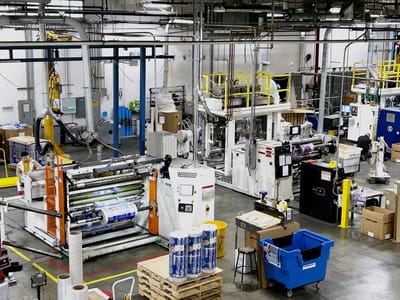
PRODUCTION LINE — INSTALLED AND RUNNING 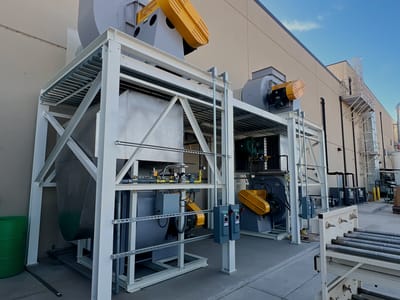
COLLECTOR PACKAGE — RIGGED


Coverage for food and beverage plants
| Scope | Coverage |
|---|---|
| Installation, field services, and rigging | 600 miles from Sacramento |
| Preventative maintenance programs | 300 miles from Sacramento |
| Full EPC delivery | 300 miles from Sacramento |
| Engineering and design | Nationwide |
| Fabrication and shipping | Nationwide |
Design-only and design-build-ship work goes anywhere in the country. We regularly design and build equipment that ships to plants we never set foot in.
Divisions
Related services
Industrial Equipment Installation and Integration
Industrial equipment installation inside live plants. Structural supports, rigging, utility tie-ins, and commissioning support. 600 miles from Sacramento.
Custom Processing Equipment Design and Build
Custom processing equipment, skid systems, and automated material handling. Sanitary washdown design, PLC-ready. Engineers and fabricators under one roof.
Specialized Industrial Enclosures
Process, hazardous-area, food and pharmaceutical, and equipment enclosures. Explosion rooms and clean process rooms designed, built, and installed.
Utility Tie-Ins and Process Piping
Process utility piping, industrial plumbing, secondary containment, air and environmental systems. Bundled with a project or contracted standalone.
Portfolio
Related project work
OEM Equipment Install in a Live Plant, Zero Unplanned Downtime
OEM equipment installed inside an active manufacturing and processing facility with no extended shutdown window. No unplanned downtime occurred.
Dust Collection and Air Handling System Installation
Dust collection and environmental system installation, including a large-scale process enclosure and air handling package inside operating facilities.
Coverage
- 600 mi
- Field services, installation, fabrication delivery, and rigging from Sacramento
- 300 mi
- Full EPC delivery and preventative-maintenance programs
- Nationwide
- Engineering, design, and fabrication for shipment
Common questions
Can you install processing equipment without shutting the line down?
Often, partially. Very few installs are truly zero-downtime end to end, but most can be structured so the only down portion is the tie-in itself. We prefabricate supports, platforms, and utility runs in the shop, stage them on site, and compress the live window to hours instead of days. On our documented case study the requirement was a live facility with no extended shutdown window, and no unplanned downtime occurred.
Do you build equipment as well as install it?
Yes, and the two are separate service lines. We design and build custom processing equipment, skid-mounted process systems, automated material handling, sanitary washdown machinery, structural frames, machine bases, and custom access systems integrated into machinery. We also install equipment you purchased from someone else. Most food clients use both at different points: a custom transfer or handling machine we designed, and an OEM filler we did not.
Will your work hold up to caustic washdown?
That depends on decisions made at design time, which is why we ask about your sanitation SOP before we detail anything. Sanitary design, washdown-compatible construction, corrosion-resistant material selection, smooth surfaces, and minimal debris traps are standard design considerations on our food work. Tell us the cleaning chemistry, temperature, and pressure and we select material and finish accordingly.
Who handles the utilities: process piping, air, and exhaust?
We do, either bundled with the installation or as a standalone scope. Plumbing scope covers process utility piping systems, industrial plumbing, and secondary containment. Mechanical scope covers air and environmental systems, process utility systems, material handling systems, process equipment integration, and containment and safety systems. See utility tie-ins and process piping for the full scope definition.
Do you work with our OEM's installation requirements?
Yes, and we work alongside OEM representatives as a normal part of the job rather than around them. We establish scope boundaries in writing before work starts, between OEM responsibilities, facility scope, and installation activities, and we align our work to the OEM's published installation requirements. If your purchase agreement has specific installer conditions, send them with the RFQ and we will confirm we can meet them.
Can you maintain the equipment after it is installed?
Within 300 miles of Sacramento, yes, on a subscription program. Scheduled preventative maintenance visits, replacement of filters, belts, and agreed-upon consumables, lubrication and minor adjustments, verification of safety devices and interlocks, and facility condition assessment with photographic documentation of deficiencies. Program tiers are recommended based on the needs of the facility. See preventative maintenance programs.
Send the equipment drawing and your sanitation window
Those two things tell us more than a scope narrative will. Add a photo of where the machine has to go and the access route it has to travel, and we can tell you quickly whether the plan is realistic.