Industrial Equipment Installation in San Jose and Silicon Valley
San Jose is 121 miles from our shop — I-80 west, then I-880 south, about two hours. It is the market where the phrase industrial equipment installation means something different from everywhere else we work.
In a food plant, a piece of equipment has to be level, aligned, and connected. In a precision manufacturing facility, it also has to be *quiet*. A metrology tool, a lithography step, an electron microscope, or a wafer inspection system will produce garbage data on a platform that is structurally perfect but transmits floor vibration. The support structure is part of the instrument.
That makes the engineering, not the welding, the hard part — which suits a shop that keeps engineers and fabricators in the same building.
Coverage
- 121 mi
- Rancho Cordova shop to San Jose, I-80 to I-880
- ~2 hr
- Drive time outside commute windows
- 300 mi
- Inside the full EPC and preventative-maintenance band
- 600 mi
- Field services, fabrication delivery, and rigging
What We Build for Silicon Valley Facilities
Tool support platforms and equipment bases. Structures designed to a vibration criterion as well as a load case — mass, stiffness, isolation strategy, and connection to the building all treated as design variables rather than defaults.
Equipment platforms, mezzanines, and access steel. Elevated platforms for support equipment, pumps, chillers, abatement, and gas cabinets, with the access and guarding to service them safely.
The full detail
Sub-fab and utility support steel. The structure that carries the pumps, abatement units, chillers, piping, and cable trays underneath and behind the tools, threaded through space that is already full.
Gas and chemical handling enclosures. Cabinets, enclosures, and containment for specialty gas and chemical systems, engineered to the classification, the relief requirement, and the monitoring the facility needs.
Custom handling and transfer equipment. Carts, lifts, fixtures, transfer mechanisms, and one-off handling equipment built around a specific tool, a specific doorway, and a specific pair of hands.
Precision weldments and machine frames. Frames and weldments held to tolerances that matter, stress-relieved where required, and machined after welding when flatness or parallelism is specified rather than hoped for.
What Silicon Valley Actually Manufactures
The design work is famous and the manufacturing is quieter, but it is very much here. California carries on the order of 600 semiconductor-related facilities and roughly 63,000 semiconductor jobs, and a large share of the equipment, materials, and pilot-line manufacturing sits in this valley even where high-volume production moved elsewhere.
Applied Materials in Santa Clara builds the equipment that makes chips — one of the largest semiconductor capital-equipment manufacturers in the world — and Lam Research does the same from Fremont. That distinction matters to a fabricator: equipment manufacturers need machine frames, precision weldments, and handling fixtures, which is a different order book than a fab needs.
The full detail
The chip companies themselves cluster tightly: NVIDIA, AMD, and Marvell in Santa Clara, Western Digital and SK hynix's US operations in San Jose, Cisco in San Jose. Bloom Energy is headquartered in San Jose, though its solid-oxide fuel cell manufacturing runs out of Fremont — a useful reminder that in this valley the head office and the factory are frequently in different cities, and it is the factory that needs a fabricator.
Geographically the industrial work concentrates along the I-880 corridor, through North San Jose and out toward Alviso, and across the Golden Triangle in Santa Clara. Below the marquee names sits a deep bench of contract manufacturers, medical device firms, cleanroom builders, specialty gas suppliers, and precision machine shops — and those are frequently the companies that actually call a fabricator, because the marquee names buy through facilities departments and general contractors.
Two honest notes about competing here. First, this valley has its own dense population of precision fabricators and machine shops, several of them very good, so we are not the obvious local choice at 121 miles. Second, what we can offer that most of them cannot is engineering, structural fabrication, and field execution as one scope — most precision shops do not do structural steel, and most structural shops do not hold precision tolerances.
Getting to Your Silicon Valley Facility
121 miles, roughly two hours on I-80 and I-880 outside commute windows, and materially longer inside them. Like the East Bay, this is a market where traffic sets the schedule more than distance does.
At two hours, we work the way we do at distance rather than the way we do at home: one thorough field-verification visit rather than casual iteration, everything fabricated against measured dimensions, and trucks arriving with the assemblies, the fasteners, the touch-up, and the spares. A forgotten item at 121 miles is most of a day.
Tool moves and installations get staged locally. A crew that has to be inside a fab at the start of a maintenance window does not begin the day with a two-hour drive — that is how windows get missed. San Jose also pairs with an Oakland run on the way in, which we schedule together when both are open.
Two Silicon Valley Constraints Worth Planning Around
Vibration criteria, not just load. Precision equipment is specified against generic vibration criterion curves — the VC series, VC-A through roughly VC-G — which describe allowable vibration velocity across a frequency band. These are not informal rules of thumb: the criteria originated with Colin Gordon and Eric Ungar in the early 1980s and were standardized by the Institute of Environmental Sciences and Technology as IEST-RP-CC024, "Measuring and Reporting Vibration in Microelectronics Facilities." A tool that requires VC-C or better cannot simply be bolted to a mezzanine that satisfies a strength and deflection check; the platform's mass, natural frequency, damping, and connection to the building structure all determine whether the tool works. Designing for it means treating the platform as a dynamic system: heavier where mass helps, stiffer where frequency matters, isolated where transmission is the problem, and sometimes structurally divorced from the building entirely. What we need from you is the tool vendor's vibration specification, early, in writing. Without it, any platform quote is a guess, and a platform that fails a vibration criterion after fabrication is not something you can weld your way out of. Confirm criteria with the tool vendor and your facility's vibration consultant.
Fab uptime economics decide the window, and the window is small. Downtime in a production fab is measured in very large numbers per hour, which means tool moves and installations happen inside tightly choreographed maintenance windows with multiple trades hooked up in sequence. The practical requirements are unforgiving: prefabricate everything, arrive with the work already done, follow the facility's protocol for foreign object debris and electrostatic discharge, and understand that hot work near a tool or a cleanroom is frequently prohibited outright rather than merely permitted. We plan for bolted and mechanically fastened connections in those areas rather than assuming we can weld in place, and we assume a pre-task briefing and escort. Confirm the specific protocol with your facility.
Published 2026 Budget Pricing
We publish our numbers. Vibration-criterion tool platforms and precision weldments are quoted per project — the specification drives them far more than the tonnage. The ranges below cover the standard structural and access scope.
| Item | 2026 budget range |
|---|---|
| Heavy industrial steel mezzanine | $35,000–$75,000+ |
| Light-duty steel mezzanine | $18,000–$35,000 |
| Guardrail system, 42" OSHA | $165–$225 per linear foot |
| Fixed ladder, 20–30 ft | $3,500–$7,500 |
| Steel-framed roof access hatch | $3,500–$8,000 |
| Mechanical or generator enclosure | $8,000–$25,000+ |
Fabrication only. Final pricing moves with material selection, structural requirements, engineering review, finish type, complexity of fabrication, and project scope and quantity. Installation is quoted after a site visit and field review. See the full 2026 price guide →
Related Work
OEM equipment install, live plant → — Structural and access steel prefabricated off site, equipment set with our own rigging crew, utilities tied in, handed over ready for commissioning, on schedule with zero unplanned downtime. The pattern a tool move requires.
Explosion room enclosure → — A hazardous-area enclosure engineered to the classification and the relief requirement. Relevant to specialty gas and chemical handling, where the enclosure is a safety system.
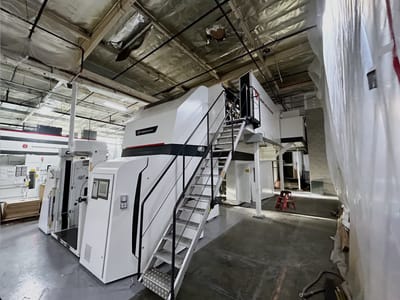
OEM EQUIPMENT INSTALL — ACCESS STAIR AND PLATFORMMANUFACTURING · LIVE PLANT · DWG PRJ-01 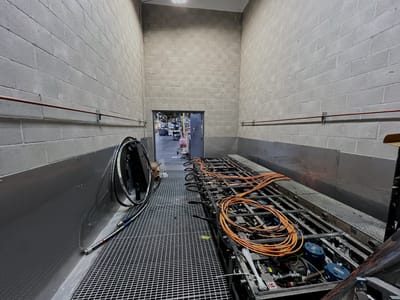
EXPLOSION ROOM — GRATING DECK AND SERVICESCHEMICAL PROCESSING · DWG PRJ-04


Service area
Nearby
Divisions
Related services
Industrial Equipment Installation and Integration
Industrial equipment installation inside live plants. Structural supports, rigging, utility tie-ins, and commissioning support. 600 miles from Sacramento.
Custom Processing Equipment Design and Build
Custom processing equipment, skid systems, and automated material handling. Sanitary washdown design, PLC-ready. Engineers and fabricators under one roof.
In-House Rigging and Equipment Setting
Fully in-house industrial rigging. Receive, offload, stage, and set equipment with our own personnel. 600 miles from Sacramento.
Industries
Industries this work runs in
Manufacturing and Assembly Line Equipment Installation
Manufacturing and assembly line equipment installation in live plants. Rigging, structural supports, utility tie-ins, commissioning support.
Chemical Processing Equipment and Containment
Chemical processing contractor: hazardous area enclosures, secondary containment, process piping, and equipment installation inside live plants.
Packaging Line Installation and Integration
Packaging line installation and integration. Fillers, cappers, labelers, case packers, palletizers, conveyors. Set, tied in, and ready to commission.
Portfolio
Related project work
OEM Equipment Install in a Live Plant, Zero Unplanned Downtime
OEM equipment installed inside an active manufacturing and processing facility with no extended shutdown window. No unplanned downtime occurred.
Explosion Room: Hazardous-Area Enclosure Build
A hazardous-area enclosure designed, fabricated, and installed by Miller 3 Engineering. Containment, relief, and utility penetrations in one scope.
Coverage
- 600 mi
- Field services, installation, fabrication delivery, and rigging from Sacramento
- 300 mi
- Full EPC delivery and preventative-maintenance programs
- Nationwide
- Engineering, design, and fabrication for shipment
Frequently Asked Questions
Can you design a platform to a vibration criterion, not just a load?
Yes, and it is a genuinely different design problem. Send us the tool vendor's vibration specification — which VC curve or velocity limit applies — along with the tool weight, footprint, and where it has to sit. Our engineers treat the platform as a dynamic system: mass, natural frequency, damping, isolation strategy, and how it connects to the building all become design variables. What we cannot do is retrofit vibration performance into a platform that was quoted on strength alone, so we need the specification before fabrication rather than after. Confirm the criterion with the vendor and your vibration consultant.
What do you need from us to quote a tool platform?
The tool's weight and footprint, the vibration specification, the floor construction and what is underneath it, the available headroom, the utility connections that have to route through or under the platform, and the access route the tool itself will travel. The route is the item people forget, and it is the one that most often forces a design change late.
Can you work inside a cleanroom or a live fab?
We plan for it as a constrained environment rather than a normal jobsite: prefabricated assemblies, mechanically fastened rather than welded connections in restricted areas, foreign object debris and electrostatic discharge protocol, gowning, escort, and a pre-task briefing. Hot work near tools or a cleanroom envelope is often prohibited, so we design connections that do not require it. Confirm your facility's specific protocol with us early — it changes how the steel gets detailed, not just how the crew behaves.
Do you build machine frames and precision weldments for equipment manufacturers?
Yes, and it is a distinct line of work from structural steel. Frames get designed for stiffness and dimensional stability, stress-relieved where the application requires it, and machined after welding when flatness, parallelism, or bore location is specified. Tell us the tolerance that actually matters and how it will be inspected, because "precision" without a number is not a specification we can build to.
You are two hours away and there are good fabricators here. Why would we use you?
Fair question, and we would rather answer it directly. Most precision shops in the valley do not do structural steel, and most structural shops do not hold precision tolerances — so a project needing a vibration-criterion platform, the sub-fab support steel underneath it, and a custom handling fixture typically gets split across two or three vendors with the integration left to your facilities team. We do all three under one roof with our own engineers stamping the drawings. If your project is only precision machining, or only a simple mezzanine, a local shop is probably the better call.
How do you handle the maintenance window if something does not fit?
By making that unlikely rather than by improvising. Everything gets field-verified before fabrication and trial-fit in the shop where practical, and the truck arrives with fasteners, touch-up, and spares because a missing item at 121 miles costs most of a day. When something genuinely unexpected surfaces, we have engineers reachable in real time rather than a drawing-revision process that takes a week — which is the actual argument for design and fabrication living in the same company.
Call (916) 842-7402
Send drawings, a photo, or a rough scope. We answer with questions before we answer with a number.
Miller 3 Engineering · 2530 Mercantile Dr Ste H, Rancho Cordova, CA 95742 · CA LIC #1136711